Physical Address
304 North Cardinal St.
Dorchester Center, MA 02124
Physical Address
304 North Cardinal St.
Dorchester Center, MA 02124


For many years, “stocks, bonds, and cash” constituted the fundamental trinity of investment portfolios. For wise investors seeking to diversify and possibly increase returns, a new realm of “alternative investments” offers bright futures.
By the end of this article, you’re going to know exactly “what are alternative investments” and a variety of typical “examples of alternative investments”, and you’ll learn why they’re taking the system over by storm and, with that, the key benefits as well as risks that come with them.
With a little education in alternative investments, you can broaden your investment horizon and build a stronger investment portfolio.
“Alternative investments” are financial assets that do not fit into traditional investment categories, such as publicly traded stocks, investment-grade bonds and cash. They are generally less liquid, may be less transparent and may currently be subject to less oversight than other asset types.
Objective: They are regularly requested to:
1. Real Estate (Beyond Public REITs): Owning the real estate directly (apartment building, commercial building, land) for rent or appreciation. This could be through fractional ownership in a commercial property or via a project.
2. Private Equity (PE) & Venture Capital (VC): Investing in companies that are not listed on the stock exchange.
3. Hedge Funds: Investment funds that are open to a limited number of accredited investors and that engage in a wider range of investment and trading activities than most funds, which include long/short equity, global macro strategies, and arbitrage, among others. Hedge funds also typically use leverage and may use derivatives.
4. Commodities: Base goods or raw products, as they are found in their natural state, such as gold or cattle.
5. Private Debt/Private Credit: Providing capital directly to private companies, typically those which are unable to borrow from banks or public credit markets. This lending can be structured as direct lending, mezzanine debt, or well as distressed debt.
6. Collectibles & Physical Assets: Tangible and finite products that derive value from their rarity, age or beauty.
7. Infrastructure: Spending on big public works or critical services.
8. Farms: Direct investments in 100%-owned agricultural operations or leased land to farmers or pure speculation.
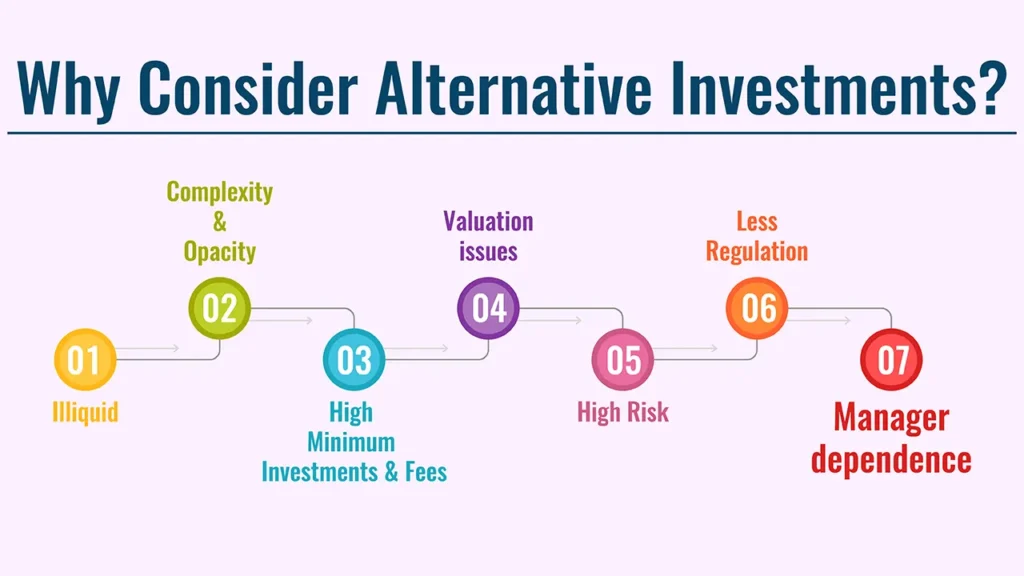
In short, “alternative investments” comprise a variety of asset classes that are not traditional stocks, bonds, or cash, which provide unique “benefits” such as diversification and potential for higher returns, which are offset by real “risks” such as illiquidity and complexity.
Despite the potential to add value to a portfolio, not every investor is right for alt investments. And like anything else, what’s most important is that you understand what they are, who they’re for, the pros of “examples, ” cons, and determine whether or not they fit into your portfolio. Seeking advice from an experienced adviser is a must before delving into such complex channels.
No recommendation or advice is being given as to whether any investment or strategy is suitable for a particular investor.
Throughout history, alternatives have only been really available to institutions (pension funds, endowments) and high-net-worth individuals (HNIs) since being out of reach for the average retail investor due to high minimums, lack of liquidity, and complexity.
But as crowdfunding or fractional ownership platforms gain popularity, access to even accredited retail investors and, by extension, non-accredited entities in a lot more geographies, India included, is increasing.
Many alternative investments have a low correlation with conventional investments such as stocks and bonds. What this means is that they are driven by different market drivers.
Alternatives may not behave as traditional markets do when they decline, which can lead to decreased overall portfolio volatility and risk.
In alternative investments, investors usually have options for higher returns compared to traditional investments, especially in private equity or venture capital.
But this opportunity does not come without its corresponding risk, such as illiquidity and increased volatility in certain forms. Returns are not guaranteed.