Physical Address
304 North Cardinal St.
Dorchester Center, MA 02124
Physical Address
304 North Cardinal St.
Dorchester Center, MA 02124


Imagine your favorite video game, only instead of simply playing it, you own a smidgen of the company that created it! That’s a bit like investing. With its magic of compounding returns, it is available to young people as a tool to make their money grow and work for the future that they want. Empower your financial future! Explore our guide on investing for teens, covering key concepts and strategies to help you make informed investment decisions.
Investing isn’t reserved for adults or the rich; it’s something that can be learned and practiced by anyone, young or old. By getting started early, teenagers can benefit from the power of compounding, learn important financial lessons, and put themselves on a path for a secure financial future.
The power of compounding is one of the most compelling arguments for beginning to invest early. Compounding is when your money makes money, and then that money makes money, and so on. Which is often a euphemism for “money making money.”
For instance if you invest ₹100 today, and if it grows by 10% every year, then, next year it becomes ₹110. The following year, it grows on ₹110 (not just the original ₹100), so you get ₹121! That is, the longer you leave your money in place, the longer it has to potentially grow.
To paint the picture better, assume you invest ₹1,000 and earn a 10% annual return. A year later, after one year you would have ₹1,100. You would have about ₹1,610 at the end of five years. But if you wait until 30 to start investing that same ₹1,000, you would need to make an investment of ₹1,610 at 30 to have the same amount at 35. The sooner you begin, the less it will take to achieve your objectives.
With decades until retirement, teenagers have ample time for their investments to grow and recover from market volatility. By investing at an earlier age, your money has more time to compound over time.
Here’s something to think about: If you begin to invest ₹1,000 per month when you’re 15, and average an annual rate of return of 10%, you can have over ₹1.5 crore when you’re 65! But if you wait until 25 to begin investing that same sum, you’ll end up with only about ₹1 crore at age 65. This demonstrates how strong the element of time is in investing.
Investing can be the key to achieving actual teen goals like a college education, your first car, travel, starting a business or becoming financially independent. If you’re saving for college, say, the more time you have to invest, the more likely you are to have enough saved to cover tuition and other expenses.
You can make things happen by plotting out financial goals and investing for them. Whether it’s earning enough for a new phone, a weekend trip with friends or a place to live in the future, investing can make it happen faster.
When done right, investing also teaches good money habits. You achieve financial discipline as you learn how to handle your money and decide appropriately – something that will be useful for the rest of your life. You will learn to budget, save, and invest wisely — all important aspects of achieving financial freedom.
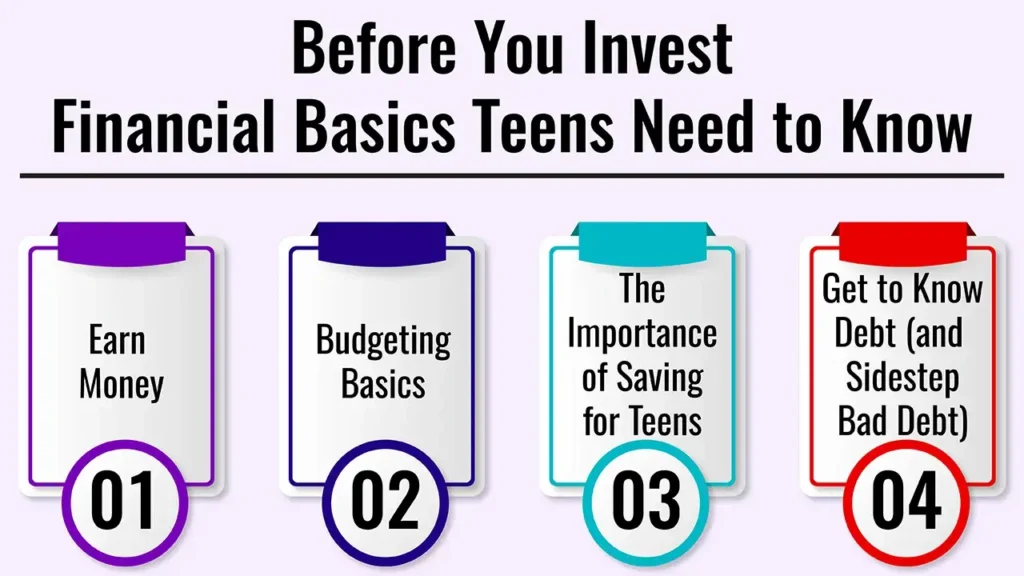
Before you can invest money, you must make money. Teens can make money in a number of ways:
Once you begin to earn money, you need to learn the basics of how to manage it. Here are some budgeting basics:
Whether you have a short-term goal or a long-term objective, saving is important. Differentiate between saving for short-term goals (a new phone or concert tickets) and investing for long-term goals (college or a car).
Emphasise the practice of saving a part of each rupee earned. For instance, you can choose to set aside 20% of your income to invest later. This behavior will support you in creating a strong financial base.
It’s necessary to comprehend debt and how to steer clear of bad debt. Provide a concise description of what interest is and how much it can grow if you let your guard down. Counsel caution with credit cards in later life and suggest steering clear of loans for items that lose value quickly — like pricey gadgets.
NOTE: For most investment accounts, a legal guardian is required (i.e. custodial account). Until they are 18,teenagers cannot fully invest on their own.
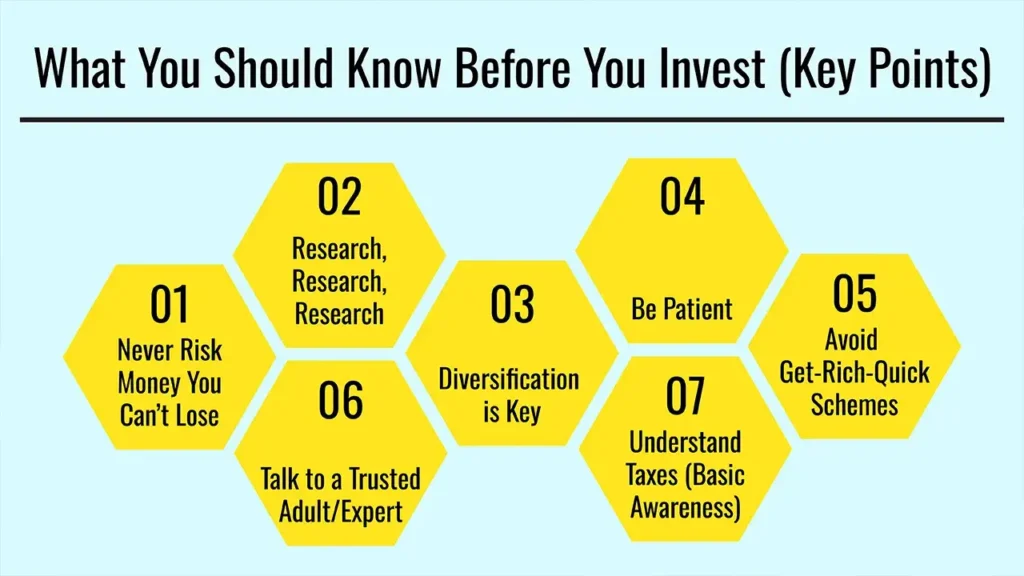
Realize that investing contains risk, and that money needed soon for essentials should not be invested. You want to have a safety net before you start investing.
Advise the teens to do their homework before committing. Don’t invest just because a friend did. Know what you are buying, including a company’s business model, its leadership and its financial health (in the case of stocks).
Few all the eggs in one basket. Diversify your investments among different companies or different types of investment to minimize risk.
Investing is a marathon, not a sprint, after all. It’s O.K. if values decline briefly. Markets have their ups and downs, and it can be helpful to keep the long-term in mind.
We can warn against empty promises and scams. If it sounds too good to be true, it likely is.
Urge teens to talk through investing strategies with parents, guardians or a financial adviser. Guidance can guide to help make those decisions.
Very briefly, indicate that returns on investments may be taxed at a later stage in life, but don’t delve into complicated explanations. Potential tax consequences are important to consider as well.
In conclusion, investing the smart way means taking out and executing the game plan -develop a strategy, do your homework, seek out the available choices and staying to the course. Learning to handle money and investments is a critical life skill that enables teens to take control of their money.
Investing While still in their teens, they can also set themselves on a path to a lifetime of financial success by learning about investing on their own. The earlier you begin, the more compounding can do for you, and the more time you have to grow your investments.
Begin learning to invest now! And talk to your parents about your investing ideas, and open a savings account to get going!
Minors can invest help from guardian in India but they can not open the investment accounts on their own until they are 18.
A 16-year-old can invest in the stock market through a custodian account with a parent or legal guardian.
Teenagers can invest in the PPF (Public Provident Fund) account and fixed deposit, which is considered a safe mode of investment with assured returns.