Physical Address
304 North Cardinal St.
Dorchester Center, MA 02124
Physical Address
304 North Cardinal St.
Dorchester Center, MA 02124


Though many of us are savvy to the residential real estate market, the much larger and more vibrant commercial real estate (CRE) market does its own heavy lifting to keep the economy moving, providing the physical floorspace for the businesses that innovate and provide for each community.
In this piece, we will discuss the definition of commercial real estate and its categories as well as what makes it an attractive investment practice and the anchor of businesses.
Commercial Real Estate Commercial real estate is any property used for business purposes or brick-and-mortar businesses, whether to provide a working place, to offer merchandise or to provide manufacturing facilities.
How do you make money with commercial real estate investment? CRE makes money mostly through rental income (charging businesses rent for using its space) and capital appreciation (increase in the value of the property over time).
Commercial real estate is a large ecosystem involving various types of property, having its specific features and conditions. Here are the primary sectors:
Buildings intended for commercial use, providing spaces for administrative work, meetings, and working.
Categories: Class A, B, and C divided by geography, age, amenities, and construction quality (Class A: high quality, premium; Class C: old, basic).
Typical Features: Open-plan layouts, individual offices, shared spaces and state-of-the-art facilities are common.
Sites where commodities & services are exchanged with the final users.
Key Attributes: The location needs to be prime, visible and have a high foot traffic. Leases usually involve a basic rent plus a % of sales (called a percentage lease).
Plants and centres for production, storage, manufacturing, logistics, and so on?
Traditionally positioned beyond city limits near transportation hubs (roads, rail, ports). The supply chain is driving demand.
Residential buildings with a number of rental units to be rented to tenants. Residential, but if you own them for income from multiple units (usually 5+) – the real estate is considered commercial real estate.
Key Features: Generate predictable streams of rental income. Valuation typically is based on the number of units and potential rental income.
Buildings, structures or buildings used for lodging or feeding of travellers and guests.
Key Features: Performance is closely linked to tourism, economic patterns and events. Streams of revenue are room rates, food and beverage and so on.
Special-purpose properties intended for use by a very specific user that aren’t readily compatible with other uses are often difficult to adapt to other uses.
Examples: Amusement parks, churches and schools theaters, museums, self-storage facilities car washes, parking garages data centers sports arenas golf courses
Features: Typically very tailored to their function. Valuation tends to be more challenging as there are fewer comps available. May be resistant in certain niches.
Raw land is undeveloped land that you can purchase for development, farming, or speculation.
Typical Sub-types: Raw land, farm and ranch land, infill land (within developed areas), and brownfield properties (previously developed, necessitating cleanup).
Key features: Required investments: None. High upside potential with zoning or development. Could be the riskiest (but also the most lucrative) depending on location and future development.
Individual properties or mixed-use complexes (such as stores on the first floor, offices on a higher floor and residential units on top).
Hallmark Features: Strive to have vibrant communities that offer a complete lifestyle with living, working and shopping available in close proximity. Offer diversification within one project.
Overall, commercial real estate is a broad and complicated asset class with different types of properties meeting different types of business demands and investment goals. To the layman, being able to tell these definitions and classes apart is every budding commercial investor’s first port of call.
Get to know more information: See our step-by-step resources for individual types of commercial property! Chat with a commercial estate expert…basically get into commercial real estate, bro!.
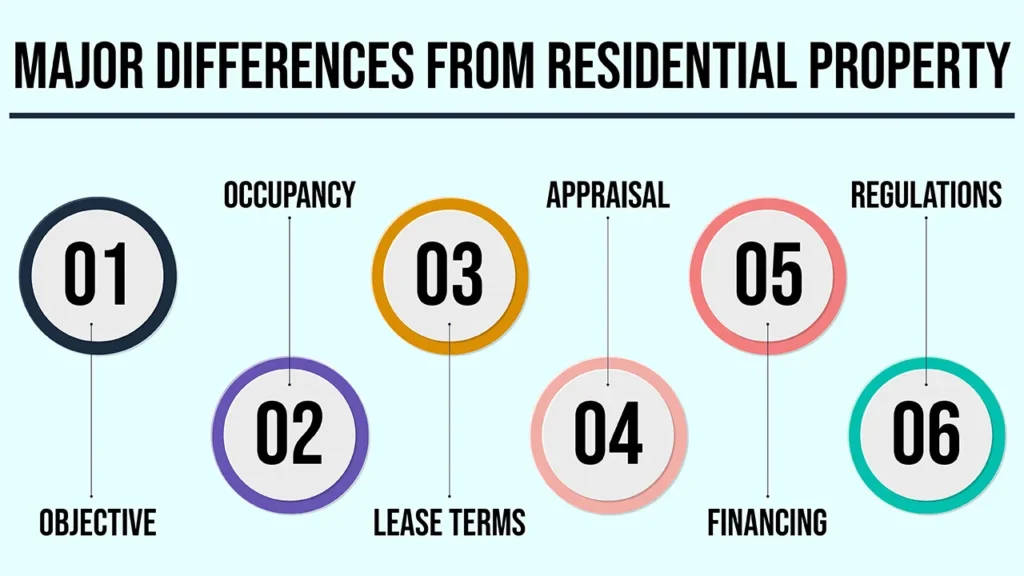
The main contrast is the residents are to live in residential properties, whereas commercial properties are for conducting business and earning rents.
Apartment buildings with five or more units (residential) are considered commercial real estate and thus are held for income, while buildings with four or fewer units are considered residential and thus are not held for income.
A “Class A” office building is a prime piece of property that features high-grade construction, desirable locations and premium amenities, which can result in higher rental rates.