Physical Address
304 North Cardinal St.
Dorchester Center, MA 02124
Physical Address
304 North Cardinal St.
Dorchester Center, MA 02124


Provide your family with effective financial planning for special needs. Explore expert advice and resources to build a secure financial future together.
Financial Planning for Special Needs Families (2025) is an important part of making sure that loved ones who need ongoing care and protection continue to receive the help they will need down the future.
Special families needing planning have unique financial problems, including but not limited to the cost of health care and trying to keep their loved ones eligible for government benefits as they work toward a secure financial future.
This is an article that introduces some of the most important aspects of financial planning that all families with a special needs member need, and it provides specific examples of what can be done now and over the long term in order to maintain stability today while we all also plan for a stronger future.
Financial planning is the process of setting, planning for, and achieving (if not exceeding) all goals or objectives involving money. For families with special needs, the process is not only about traditional planning goals but also about unique tools and protections.
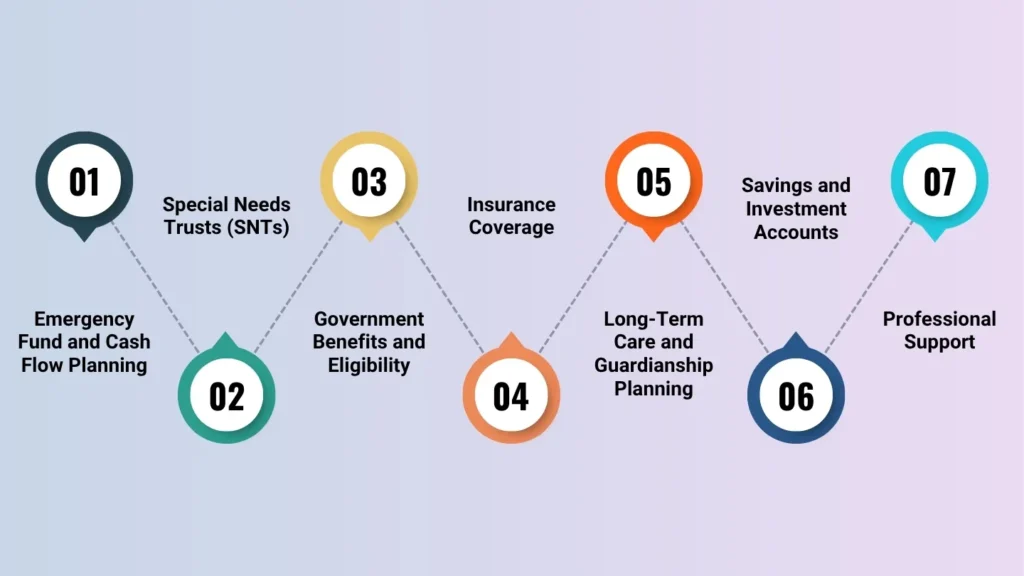
Having an emergency fund that can cover 6-12 months of living expenses is also key in dealing with unforeseen expenses, such as a medical emergency or caregiving.
Knowing what income and expenses are now, and what they’re expected to be in the future, can provide a clearer picture of monthly cash flow—ultimately enabling educated budgeting and saving plans.
A special needs trust is a traditional financial planning foundation. They support the special needs person while protecting any assets from counting against him or her for purposes of qualifying for government aid (such as Medicaid and Supplemental Security Income (SSI)).
Trusts: You may have a first-party trust that is funded with your own assets, a third-party trust funded by family members, or a pooled trust where the resources of many individuals with disabilities are combined for investment purposes.
Government benefits are a lifesaver, but families must strategize creatively to avoid disqualification. Programs like SSI and Medicaid are “asset tested,” so financial planning is about how assets should be saved, or held, in order to not threaten benefits. Registering for disability systems and applying for deductions in the terms are good financial decisions.
Adequate insurance protections are essential. Medical and therapeutic treatments are covered by full health insurance. Life insurance policies, including specialized ones such as second-to-die policies, are another way to provide financial support after the caregivers have passed by titling them into trusts.
Disability insurance and long-term care insurance are in tune with the general risk management concept.
Care continuity must be considered in the planning beyond the life of the parents. Creating legal guardians, support/supported decision-making, and trusts to provide for the care of a special needs family member.
A “Continuity of Care” plan that records daily routines and medical requirements can enable future caregivers to offer continuous support.
Tax-advantaged saving plans such as accounts allow families to save for disability-related expenses without compromising eligibility for benefits. Families should be careful not to directly title savings after the person with special needs, as that could jeopardize government support.
Working with financial planners versed in special needs can make it easier to navigate the complicated planning process. These experts help with trust establishment, benefit maximization, investment strategy and legal organization.
| Planning Tool | What It Does | Reasons to Incorporate |
|---|---|---|
| Emergency Fund | Covers unexpected expenses | Provides a financial cushion for emergencies |
| Special Needs Trust (SNT) | Holds assets for the beneficiary without impacting benefit eligibility | Protects assets and retains public benefits |
| Government Benefits (SSI, Medicaid, tax deductions) | Income, healthcare and tax relief | Provides income, health care coverage, or tax relief |
| Health & Life Insurance | Long-term medical support and medical life insurance | Protects against high medical costs |
| Funds 529 ABLE Savings Accounts | Tax-advantaged savings account for disability-related expenses | Funds used in trust care without compromising government benefits |
| Guardianship & Legal Planning | Ensures proper decision-making for the child | Ensures that your child is properly taken care of |
It’s not as easy for financial planning for special needs families. It requires a series of careful steps, specialized knowledge, and ongoing commitment.
Through creating a system of financial resources that includes trusts, benefits, insurance, savings and legal protections, families can provide the means to help their loved ones achieve a meaningful and fulfilling life long after they are gone.
Early action and professional advice can help bring peace of mind, as well as financial resilience in 2025 and beyond.
This whole child strategy provides special needs families with the tools to address issues head-on, while concurrently pursuing and achieving opportunities.
There are several, but when preparing for a disabled person, the most important is the Special Needs Trust (SNT), as it shields the inheritee’s assets and does not risk loss of government benefits.
It is best to have between 6 and 12 months of living expenses in an emergency fund in order to be able to handle unexpected costs.
There are ways that families can save and invest without jeopardizing their benefits by planning ahead, like utilizing Special Needs Trusts or ABLE accounts.
It would be ideal to start planning as soon as one can, even shortly after diagnosis, in order to take advantage of different programs and financial solutions.
Absolutely, working with special needs planning advisors can help navigate multi-faceted legal and financial terrain and provide broader coverage.