Physical Address
304 North Cardinal St.
Dorchester Center, MA 02124
Physical Address
304 North Cardinal St.
Dorchester Center, MA 02124


Explore our comprehensive guide on Debt Relief: What It Is, detailing different methods and how they can empower you to regain control of your finances today.
Are you feeling overburdened by debt? There are solutions, and you’re not alone. Are you having trouble sleeping because of your outstanding bills? Debt plagues many people, but there are many different forms of debt relief tailored to that burden.
Knowing your choices is the key to financial freedom and empowerment. Explore our comprehensive guide on Debt Relief: What It Is, detailing different methods and how they can empower you to regain control of your finances today.
Debt relief is a general category that encompasses various approaches and programs used to erase, manage, or minimize debt. The main objective in debt relief is to enable a debtor to escape a potential negative balance from excess borrowing and, in general, to dispose of the debt.
It’s finding a way to get in a place where you can pay a sustainable amount on what you owe or start over. Whereas “paying off debt” is geared toward repaying balances, debt relief has a broader focus on reducing stress surrounding your debt.
Typical objectives for debt relief are to reduce the debtor’s monthly payment, lower the interest rate being paid, and pay down the debt sooner. For a general overview of debt relief options, you can consult USA.gov’s section on getting help with debt.
Explanation: Non-profit credit counseling organizations facilitate DMPs to assist an individual in managing their debt more efficiently.
How it works: The agency works closely with your creditors to lower interest rates, waive fees, and consolidate your monthly payments into a single, consolidated monthly payment to the agency, which then divvies out the funds to your creditors. Accounts remain open, though they can be “closed to new charges.”
| Pros | Cons |
|---|---|
| Lower interest rates | Must maintain steady payments (no misses) |
| Single monthly payment | Not all types of debt may be included |
| Structured repayment timeline | Existing credit accounts may be closed |
| Avoids taking new loans |
Best For: Consumers who have manageable credit card debt and are seeking lower interest rates and a structured payment plan.
The process of combining multiple debts into a single, new loan or credit facility.
How it Works (Personal Loan): Get a new (typically unsecured) loan to pay off higher interest debt. You then make a single monthly payment to the new lender.
What it is (Balance Transfer Credit Card): Pay off other high-interest credit card balances. Transfer high-interest credit card balances to a 0% introductory APR credit card for a set time.
| Pros | Cons |
|---|---|
| Streamlined payments | Possible origination fees |
| Avoids multiple due dates | Balance transfer fees |
| Fixed repayment period | |
| May improve credit score |
Best For: People who have good credit and can get attractive rates, and people who are disciplined about their spending.
Working with creditors to settle a debt by paying a lump sum that is less than the amount owed.
How It Works: Typically, you stop paying your creditors (which ruins credit) and instead save money in a special account until you have enough to negotiate with creditors. This is often done through a debt settlement company.
| Pros | Cons |
|---|---|
| Pay less than owed | Severe credit damage |
| Stop collection calls | Risk of creditor lawsuits |
| Avoids bankruptcy | |
| Stop collection calls |
Best For: People with high unsecured debt who are in financial hardship, and possibly considering bankruptcy.
A legal procedure for dealing with debt problems of individuals and businesses; specifically, a case filed under one of the chapters of title 11 of the United States Code (the Bankruptcy Code)
How it Works (Chapter 7 – Liquidation): Non-exempt assets are liquidated to satisfy creditors, and most unsecured debt is discharged (erased).
How it Works (Chapter 13 – Reorganization): You have a court-approved repayment plan for 3-5 years, and you are making payments to a trustee who, in turn, pays creditors. Any other unsecured debts are discharged after the plan.
| Pros | Cons |
|---|---|
| Ends creditor harassment | Ruins credit for 7–10 years |
| Wipes out many debts | Non-dischargeable debts remain |
| Legal protection from creditors | |
| Fresh financial start |
Best For: Those with the worst level of debt they can’t repay using other options, often as a last-ditch measure.
Not a “relief program,” but the statute of limitations on debt collection is still important.
How it works: A credit agreement/contract with a creditor (whom you owe money) has a statute of limitations period, which is the limited time creditors can sue you to collect a debt. But the debt is still there and may be on your credit report. The clock can be reset by making a payment.
| Pros | Cons |
|---|---|
| Creditors can’t sue to collect | Debt is still legally owed |
| Stops wage garnishment & lawsuits | Stays on credit report (7+ years) |
| Stop wage garnishment & lawsuits | No court judgments are possible |
Best For: Awareness, but not as a proactive “strategy.”
The following are the things that you should know when weighing the debt relief options:
Here’s how to find the best debt relief solutions to help resolve your financial troubles while avoiding a scam.
In conclusion, comprehension of the different forms of debt relief is necessary for people dealing with financial difficulties. Both choices have their own advantages and disadvantages, and understanding them can enable you to make decisions with full confidence. Debt is manageable, though remedies are not free.
Consider your predicament and carefully consider your alternatives. Check with an expert when necessary. Remember, taking back control of your finances is the first step to securing your future.
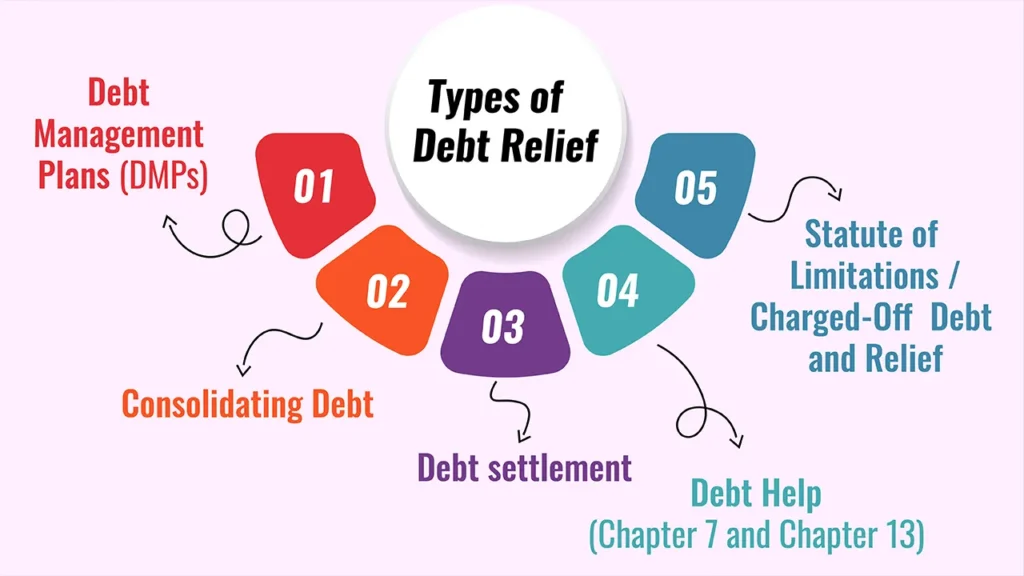
Some common ones are debt management plans, debt consolidation, debt settlement, and bankruptcy.
Debt settlement is a negotiation with creditors to pay a lump sum that is less than the full amount of what you owe, usually precluding payments for some period.
After all, bankruptcy damages your credit report for a very long time, usually 7-10 years!