Physical Address
304 North Cardinal St.
Dorchester Center, MA 02124
Physical Address
304 North Cardinal St.
Dorchester Center, MA 02124


Retirement is one common dream – to put away the daily grind and welcome in a new, free chapter of life. But for most people, the real question is, “How Much Do I Need to Save to Retire?” There is no specific number you should enter; only you can provide the right answer to that deeply personal calculation, based on the kind of lifestyle you hope to lead in the future, your current age, anticipated lifespan and the ever-looming factor of inflation.
This article will help you piece together the retirement so that you can not only gauge how much money you’ll need to build for your golden years but also construct a powerful financial planning for a secure future – no matter where you live.
Only once you’ve seen yourself in your post-retirement life can you determine how much you need.
Rising prices are a major problem when it comes to planning for the long-term financial stress. What might feel like a comfortable amount today isn’t likely to feel as comfortable 20-30 years from now. Inflation is different in different countries and economic conditions, but it’s something to factor in.
When Do You Plan to Retire? The younger you retire, the more years you will have to cover your expenses during retirement, and hence, would need a higher corpus. Some are targeting early retirement in their 40s or 50s, while others hope to work until their late 60s or even longer.
How Long Will You Live? Life expectancy is increasing all around the world as health care and living conditions get better. It is wise to assume a retirement of at least 25-30 years, if not longer, to avoid outliving your assets.
And as good as online retirement calculators are, knowing how to calculate retirement yourself is important.
A common rule of thumb is to aim to have saved 25 times your projected first year’s retirement expenses. For instance, if you want to spend $60,000 a year in retirement (in current dollars), then you would need $1.5 million.
This rule presupposes a somewhat stable withdrawal rate (generally estimated to be around 4%, although it can fluctuate depending on market conditions and personal risk tolerance).
Here is a step-by-step approach which also addresses the financial realties:
Take your current annual expenses. Then forecast that number forward to your retirement year, with an inflation rate plugged in (3%, say). Example: Annual expense at present = 50,000 * (1 + 0.03) ^ 25 ≈ $104,680.
And here is where a retirement calculator can be an enormously useful tool. It will consider your annual expenses in the future, how long you expect to live in retirement and what rate of return you expect on your investments during retirement.
Corpus Required = (Future Annual Expenses / (Expected Return Rate in Retirement – Inflation Rate)) * [Factor of life span]
Many of the financial institutions from around the world that we have compared have an online calculator that will assist you with this hard-to-calculate figure, which will consider elements such as:
Although it’s very much a personal choice, rule-of-thumb figures for a comfortable retirement tend to range from $1 million to $5 million (or more). A $40,000–$60,000 lifestyle could suffice for a simple, comfortable existence. This comes from a corpus of $1 million – $1.5 million over 25-30 years. For a large city or a more extravagant lifestyle, this amount could be doubled or tripled.
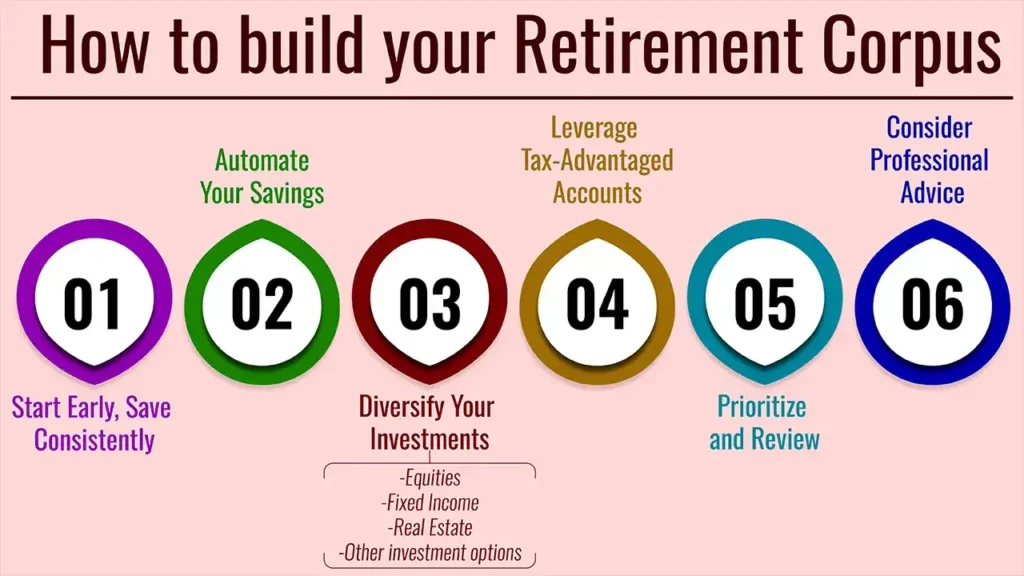
With the target corpus in mind, it is on to setting up a strong savings and investment plan next.
It’s compounding that is your best friend. The sooner you start, the less you have to save each month to hit your target. And even relatively modest routine investments can grow to a significant sum over decades.
Automate contributions to your retirement-themed investment accounts. What people don’t see, they don’t think about, and that can be a great motivator to save more.
Avoid putting all of your eggs in one basket. A balanced portfolio typically includes:
Research tax-advantaged retirement plans in your country (the United States), such as employer-sponsored plans (401(k), 403(b), 457, and pensions) or individual retirement accounts (IRAs, Roth IRAs, and RRSPs in Canada).
Retirement planning is not a one-shot deal. Revisit your plan on a regular basis (at least once a year) and make necessary updates due to changes in income, expenses, inflation or the performance of the market.
With local CFPs, you get that personal touch to set up your tailor-made retirement plan and wade through the murky world of investments while getting clarity on tax rules in your area.
Retirement planning can sound intimidating, but with a few easy steps and a head start – don’t delay – you could have a bright and secure future. Because remember, it’s not just about having as much as you can in your account.
It’s about being able to finally live the dream retirement you’ve always imagined. Take action today, decide what you want out of life, and allow the magic of regular saving and smart investing to move you closer to your goals.
It’s complicated and depends in large part on your lifestyle and where you live, but in simple terms, a realistic average “corpus” you’ll need for a comfortable retirement might be anywhere from $1M to $5M+ in terms of income associated with inflation and a long retirement.
There’s that ol’ 4% rule (taking half your portfolio in the year you retire and then adjusting for inflation) that may apply somewhat differently.
Its efficiency may be affected by factors such as how the market is performing, the level of inflation, and individual risk appetites.
Some financial planners recommend a more conservative or aggressive withdrawal approach.
The monthly savings amount would be a function of your current age, when you would like to retire, expected income need post-retirement and the target corpus. Online retirement calculators can provide an exact number for how much you need to invest each month.
As a rule, the sooner you begin saving, the smaller the percentage of your income you’ll need to save (say 10-15%); the longer you wait, the more you’ll need to save (20-30%, or more).
Ideally, yes. It can also keep your post-retirement expenses lower and make you feel even more financially secure going into retirement if you are debt-free, especially with high levels of debt such as a mortgage. That’s one way to keep your retirement money going longer.
Extremely important. Retirees are also facing significant health costs globally. That’s why its important to have good all-around health insurance and a separate medical fund (outside of your FRS) to protect your retirement savings from health-related expenses not covered by insurance.